Engine air filter, Air Filters
Symptoms Of A Bad Engine Air Filter (and How to Find the Right Size)
Oct
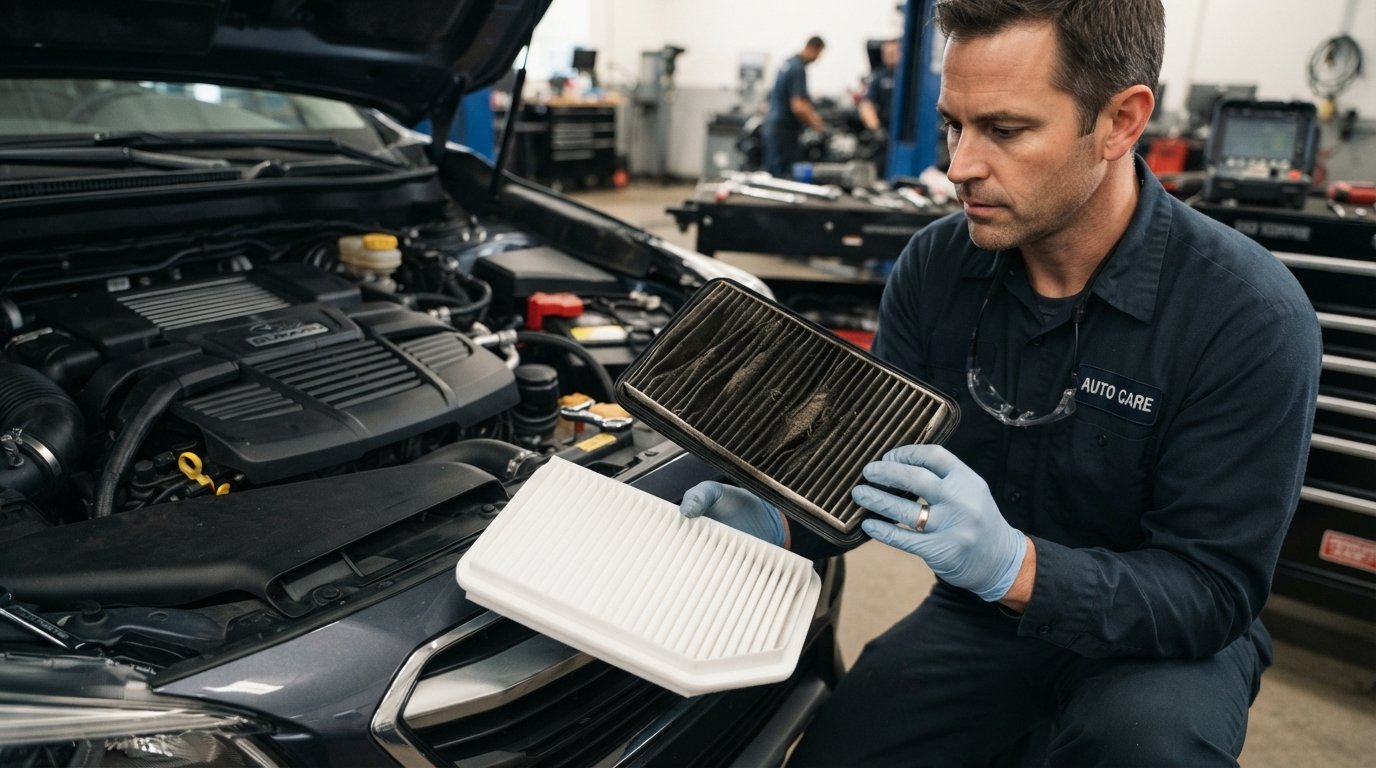
A bad engine air filter causes sluggish acceleration, reduced fuel economy, engine misfires, a rough idle, and can trigger a Check Engine light by disrupting your engine’s air-fuel ratio. Replacing a restricted air filter restores proper airflow to the combustion chamber, improving throttle response and engine efficiency. Unlike home HVAC filters, automotive air filter sizes are not determined with a tape measure – they are specified by year, make, model, and engine size to fit your vehicle’s factory airbox precisely.
Table of Contents
Top Symptoms of a Bad Engine Air Filter
An internal combustion engine requires roughly 10,000 gallons of clean air for every single gallon of fuel burned. When debris clogs the filter media, intake vacuum increases, restricting airflow and forcing the engine management computer to compensate for the air starvation.
Sluggish Acceleration and Hesitation
When you step on the gas pedal, the throttle body opens to draw in immediate air. A clogged filter restricts this sudden airflow, causing a lag in power delivery, delayed pedal response, or a sluggish feel when passing or merging onto the highway.
Reduced Fuel Economy
On modern fuel-injected engines, mass airflow (MAF) sensors and oxygen sensors detect reduced intake airflow. The engine control module (ECM) adjusts fuel delivery to maintain proper combustion. In severe cases or on older carbureted and early electronic injection setups, restricted airflow causes a “rich” condition (too much fuel, not enough air), burning excess gasoline without generating power.
Engine Misfires, Rough Idling, and Hard Starts
Air starvation destabilizes the air-fuel mixture inside the cylinders. At idle, when airflow velocity is already low, a heavily soiled filter can cause unburned fuel to soot up spark plug tips, leading to rough idling, engine vibration, or misfires upon startup.
Check Engine Light (Diagnostic Trouble Codes)
Severe air restriction triggers the Check Engine light. Common diagnostic trouble codes (DTCs) associated with a restricted air filter include:
- P0172 (System Too Rich – Bank 1): Indicates the engine is running with too much fuel relative to incoming air.
- P0101 (Mass or Volume Air Flow Sensor Circuit Range/Performance): Triggered when actual intake airflow deviates significantly from expected ECM values.
Black Smoke or Gasoline Smell from the Exhaust
If the air restriction is severe enough that fuel fails to burn completely inside the cylinder, unburned hydrocarbons travel into the exhaust manifold. This can produce a noticeable gasoline smell at the tailpipe or faint black smoke under heavy acceleration.
Visual Inspection: Clean vs. Dirty Air Filter
Checking your air filter takes only a few minutes and provides clear visual proof of whether a replacement is necessary.
What a Healthy Air Filter Looks Like
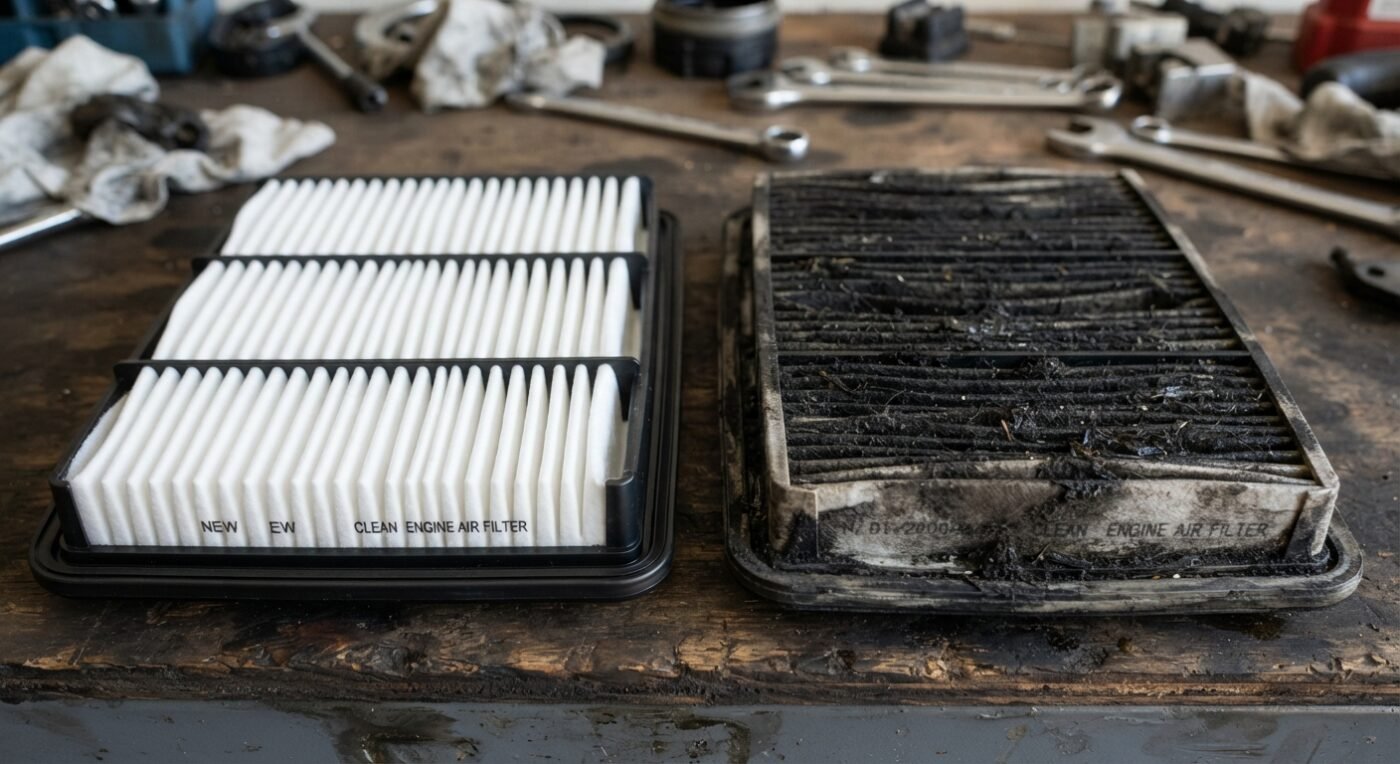
- Clean Filter: Features bright white, light gray, or distinct red (for oiled cotton K&N filters) pleated filter media. The pleat folds are straight, clean, and free of dirt accumulation, with clean rubber perimeter sealing gaskets.
What a Clogged Air Filter Looks Like
- Dirty Filter: The pleat valleys contain packed dirt, road grit, dead insects, leaves, and dark gray or pitch-black soot buildup.
- The Light-Transmittance Test: Hold the filter up to a bright light source or sunlight. If light passes cleanly through the pleat folds, the filter is still functional. If no light penetrates the media due to dense dirt buildup, the filter is fully restricted and needs immediate replacement.
How to Find Your Right Engine Air Filter Size
A common mistake DIYers make is searching for “air filter size” and attempting to measure their engine airbox using a tape measure.
Important: Automotive air filters are not sold by exterior dimensions like home furnace or AC filters. You cannot buy a “10×6-inch” car filter. Automotive filters feature exact rigid plastic frames, custom rubber sealing lips, and specific mounting tabs designed for specific airbox housings.
To find the correct air filter for your car or truck, you need the catalog part number tailored to your vehicle’s specifications:
- Check Your Year, Make, Model, and Engine Displacement: A 2.3L EcoBoost Mustang takes a completely different filter than a 5.0L V8 Mustang of the same model year.
- Cross-Reference the OEM Part Number: Look up the factory part number stamped on your original filter frame or listed in your owner’s manual.
- Select standard paper or performance media: Match that OEM number to aftermarket equivalents from brands like STP or K&N.
Ford Fitment & Part Number Reference Guide
To eliminate the guesswork, here is a direct breakdown of stocked replacement options categorized by vehicle model, production years, and engine applications:
| Vehicle Model | Production Years | Engine Application | Brand & Filter Type | Part Number | Price |
| Ford F-150 | 1988–1996 | 4.9L L6, 5.0L V8, 5.8L V8 | K&N High-Flow Panel | 33-2023 | $63.00 |
| Ford F-150 | 1997–2003 (2004 Heritage) | 4.2L V6, 4.6L V8, 5.4L V8 | K&N Round Conical | E-1570 | $78.00 |
| Ford Mustang | 2015–2023 | 2.3L EcoBoost, 3.7L V6, 5.0L V8 | STP Standard Paper | SA90140 | $17.00 |
| Ford Mustang | 2005–2014 | 3.7L V6, 4.0L V6, 4.6L V8, 5.0L V8 | K&N High-Flow Panel | 33-2298 | $64.00 |
| Ford Mustang | 1996–2004 | 3.8L V6, 4.6L V8 (GT / Mach 1 / Cobra) | K&N Round Drop-In | E-0940 | $78.00 |
| Ford Ranger | 1998–2011 | 2.3L I4, 2.5L I4, 3.0L V6, 4.0L V6 | STP Standard Paper | SA3637 | $12.00 |
| Ford Ranger | 1989–1997 | 2.3L I4, 2.9L V6, 3.0L V6, 4.0L V6 | STP Standard Paper | SA5058 | $12.00 |
| Ford Ranger | 2019–2024 | 2.3L EcoBoost I4 | STP Premium Paper | PSA8243 | $24.00 |
Model Category Direct Links
- For full-size truck replacement filters, browse our catalog of F-150 replacement air filters.
- For muscle car applications, explore Mustang performance air filters.
- For midsize truck applications, check out our inventory of Ford Ranger air filters.
Standard Paper vs. Performance Washable Filters: Which to Choose?
When replacing your air filter, you will primarily choose between two main construction materials:
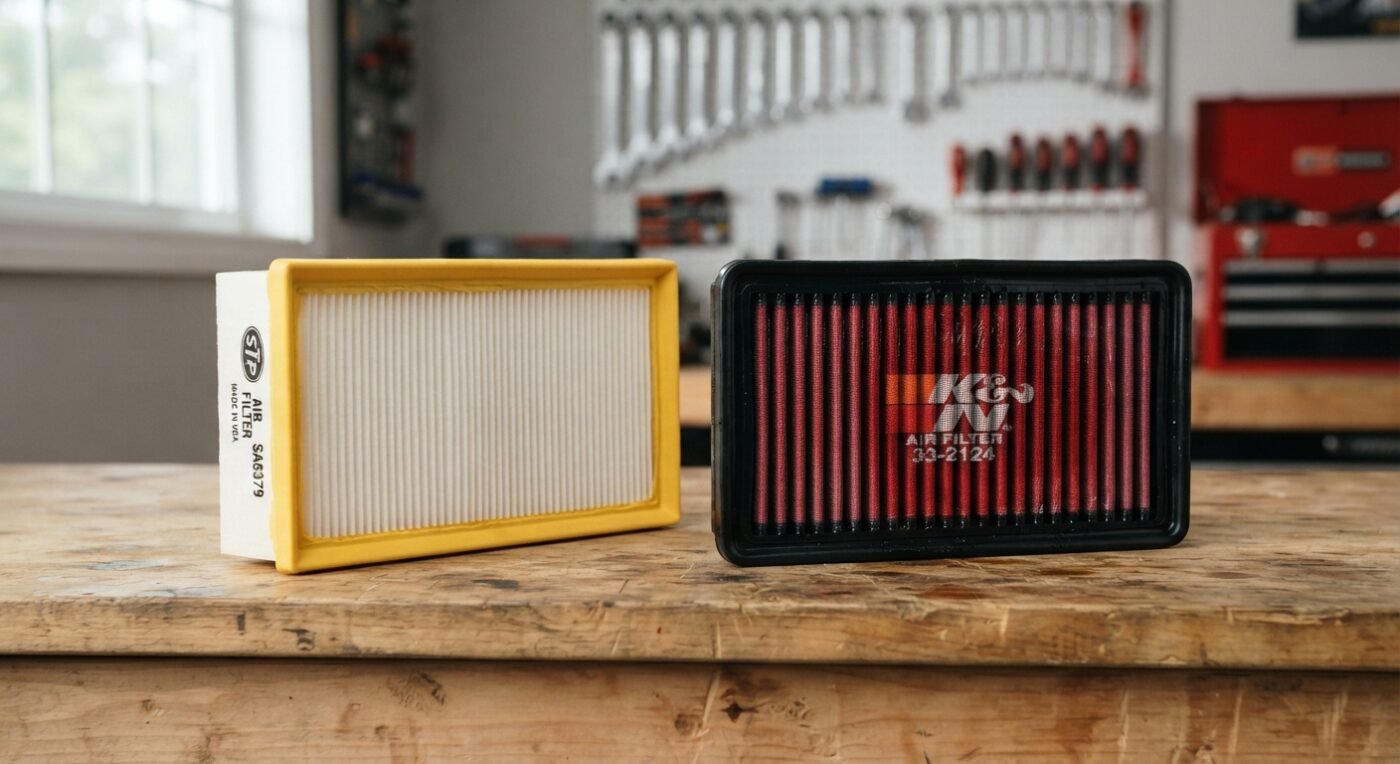
Standard Paper Filters (e.g., STP)
- Construction: Resin-impregnated synthetic paper pleats designed to trap fine dust particles down to low micron levels.
- Pros: Low upfront cost ($12.00–$24.00), simple drop-in installation, excellent micro-particle protection for standard commuter driving.
- Cons: Disposable single-use design; must be discarded every 12,000 to 15,000 miles. Restricts total airflow slightly more than performance cotton mesh under wide-open throttle.
High-Flow Washable Filters (e.g., K&N)
- Construction: Multiple layers of oiled cotton gauze sandwiched between coated aluminum wire mesh.
- Pros: Increases airflow up to 50% compared to dense paper, reusable design (wash and re-oil every 50,000 miles), backed by long service lifespans.
- Cons: Higher initial price ($63.00–$78.00); requires proper washing and light re-oiling during routine maintenance intervals to avoid over-oiling the MAF sensor.
How to Change Your Engine Air Filter Step-by-Step
- Locate the Airbox: Identify the black plastic intake box connected to the intake tube leading to the engine.
- Release the Fasteners: Unclip the 2 to 4 metal retaining clips holding the upper airbox lid. If working on select EcoBoost models, use a flathead screwdriver or 8mm socket to loosen the clamp securing the hose.
- Remove the Old Filter: Lift the airbox lid slightly and pull out the old filter element.
- Clean the Airbox: Use a clean microfiber cloth to wipe out loose dust, leaves, and grit resting at the bottom of the lower housing before installing the new filter.
- Drop in the New Filter: Position the new filter into the housing, ensuring the rubber perimeter seal rests flush along the airbox track.
- Re-seal the Airbox: Lower the housing lid back into place, latch all metal clips, and tighten any clamps that were loosened.
Frequently Asked Questions
What happens if you drive with a bad engine air filter?
Driving with a severely clogged filter restricts airflow, forcing the engine to work harder. Over time, this leads to sluggish throttle response, reduced gas mileage, increased carbon deposits on spark plugs, and potential engine misfires due to rich air-fuel mixtures.
Can a dirty air filter cause a check engine light?
Yes. If an air filter becomes severely restricted, the mass airflow (MAF) sensor will detect irregular air intake volumes, triggering fault codes such as P0172 (System Too Rich) or P0101 (MAF Sensor Performance) on your dashboard.
How do I know what size air filter my car needs?
Automotive filters are sized by catalog part number rather than physical dimensions. Look up your vehicle’s specific year, make, model, and engine size in a parts catalog, or check the part number printed on your existing filter’s rubber frame.
How often should you change your engine air filter?
Under standard driving conditions, replace standard paper filters every 12,000 to 15,000 miles or once a year. If you frequently drive in dusty, rural, or unpaved environments, inspect and replace the filter every 6,000 to 10,000 miles.
