
Cabin Air Filter, Air Filters
How Often to Change Cabin Air Filter: Ford F-150, Mustang and Ranger

Oct
Follow your owner’s manual. For the F-150, Mustang and Ranger it says replace the cabin air filter every 20,000 miles, and sooner in severe use: 10,000 to 12,000 miles on the F-150, 10,000 on the Mustang and Ranger. Ford’s general support page gives a range of 15,000 to 20,000 miles depending on model. If airflow drops or you smell something musty before then, change it early. That’s the answer. The rest of this guide covers why the numbers differ, how to tell yours is overdue, and how to swap it on each truck.
Table of Contents
What Ford says about the interval
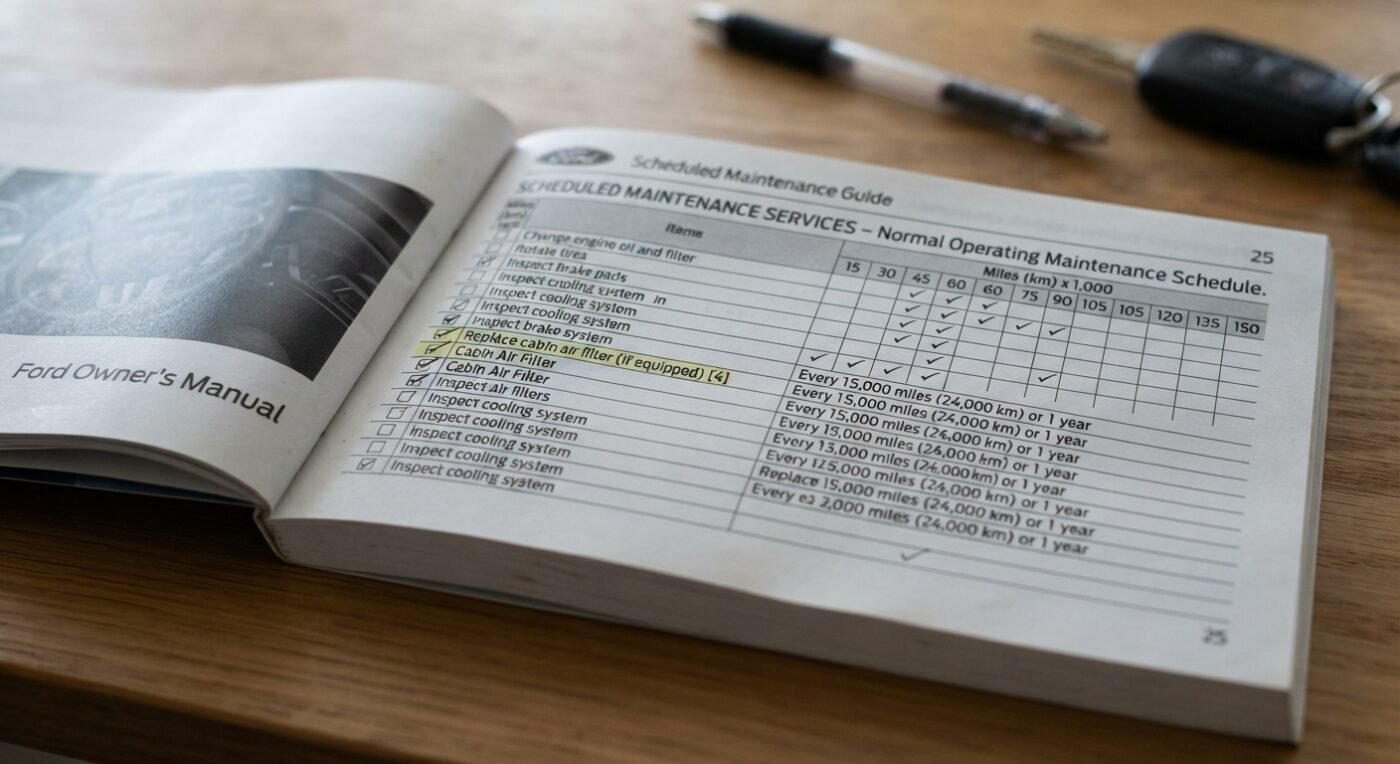
Every site you’ll find has a different number, so here are the sources that matter.
| Source | Interval | Notes |
|---|---|---|
| F-150 owner’s manual (2015–2023) | 20,000 miles or 2 years; 10,000–12,000 miles in severe use | Severe: dusty roads, construction sites, heavy idling |
| Mustang owner’s manual (2015–2023) | 20,000 miles or 2 years; 10,000 miles in severe service | |
| Ranger owner’s manual (2019–2023) | 20,000 miles; 10,000 miles in severe conditions | Severe: dusty roads, construction sites, heavy idling |
| Ford support page | 15,000–20,000 miles, depending on model | General guidance |
| Other websites | 12,000–30,000 miles | Conflicting, no source model |
The manuals say “replace,” not “inspect.” When a website gives a single number for every car, it’s averaging across makes. Use your manual for your truck.
When to change it sooner
Ford’s support page lists allergies or other respiratory problems, dirt roads or very dusty conditions, and heavily polluted areas as reasons to change the filter more often than the schedule says. The F-150 manual adds construction sites and heavy idling to its severe-use list. If any of that sounds like your daily driving, use the severe number.
If you run a washable K&N, you’re cleaning rather than replacing. K&N’s guidance, per your notes, is to clean it every 20,000 miles or once a year, more often in dust, using the K&N cleaner and refresher kit, and never oil on a cabin filter. Our best cabin air filters for the F-150, Mustang and Ranger guide compares them, including the K&N VF2049.
Signs your cabin filter is overdue
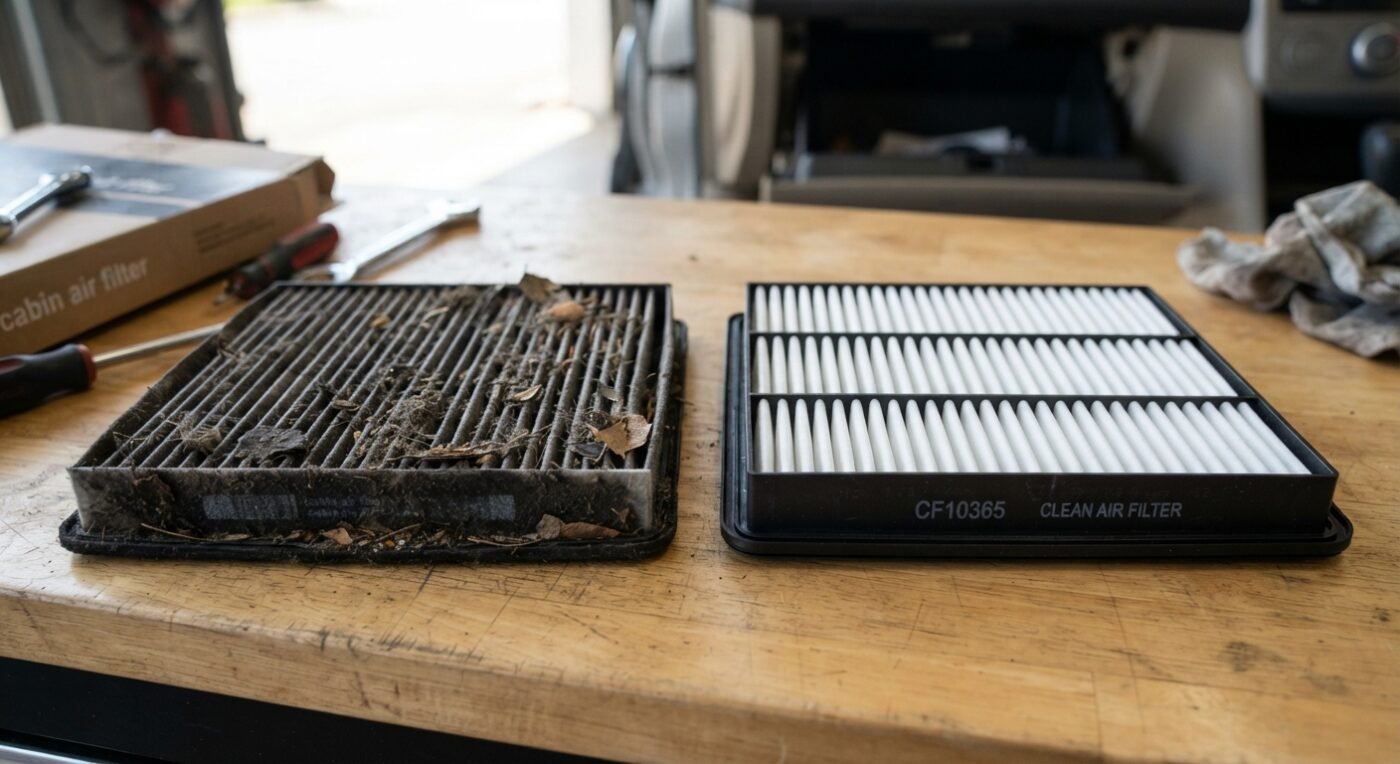
Mileage is a guideline, and the truck usually tells you first:
- Weak airflow from the vents, even at high fan speed.
- Windows that fog and take a long time to clear.
- A damp or stale smell, especially when you first start the AC or heater.
- Allergy symptoms that flare up while you drive.
A heavily loaded filter collects leaves, pine needles, bug wings, sand and a grey sludge between the pleats.
What does a bad cabin air filter smell like?
A clogged filter smells stale, like a damp basement or a wet dog, and it’s strongest when you first turn on the AC or heater. Other sites describe it as musty or like dirty socks, and several say it gets stronger when the AC runs.
The smell isn’t always the filter. Use this table before you buy anything:
| Smell | Likely cause | Will a new filter fix it? |
|---|---|---|
| Stale, damp, wet-dog | Clogged or saturated filter, or moisture in the housing or evaporator | Often, if the filter is the source |
| Dusty | Loaded filter | Yes |
| Sweet, syrupy | Leaking heater core putting coolant into the HVAC housing | No. Have a shop check it soon |
| Exhaust | Not a filter problem | No. Get it inspected, since carbon monoxide has no smell of its own |
| Rotting or animal | Debris or a nest in the housing (one owner found a nest on top of a filter) | Clear the debris first, then fit a new filter |
Cabin filter odor that won’t go away
If you changed the filter and the smell is still there, or it comes back within a week, check three things before buying another one:
- Is the filter facing the right way? Cabin filters have an airflow arrow. On all three of these trucks the arrow points down.
- Is the housing wet? The housing should stay dry. Damp filter media grows mold, and the smell can return in days. Fixing the leak comes first.
- Is the source the evaporator? One Mustang owner on a forum says swapping the filter has never fixed this smell on other cars, since the evaporator coil sits downstream of the filter. We don’t sell evaporator cleaning or A/C drain service, so if the first two checks come up clean, a shop is the next stop.
Fit the new filter last, after you fix the cause. If odor is your main complaint, a carbon filter helps with smells, while plain particulate filters don’t. On the F-150 that’s the STP Max CAF1953M. Carbon won’t cure a wet housing or a mold source.
How to change it on each model
On all three models the filter sits behind the glovebox. Note the arrow on the old filter before you pull it out, and make sure the new one faces the same way.
Ford F-150 (2015–2023)
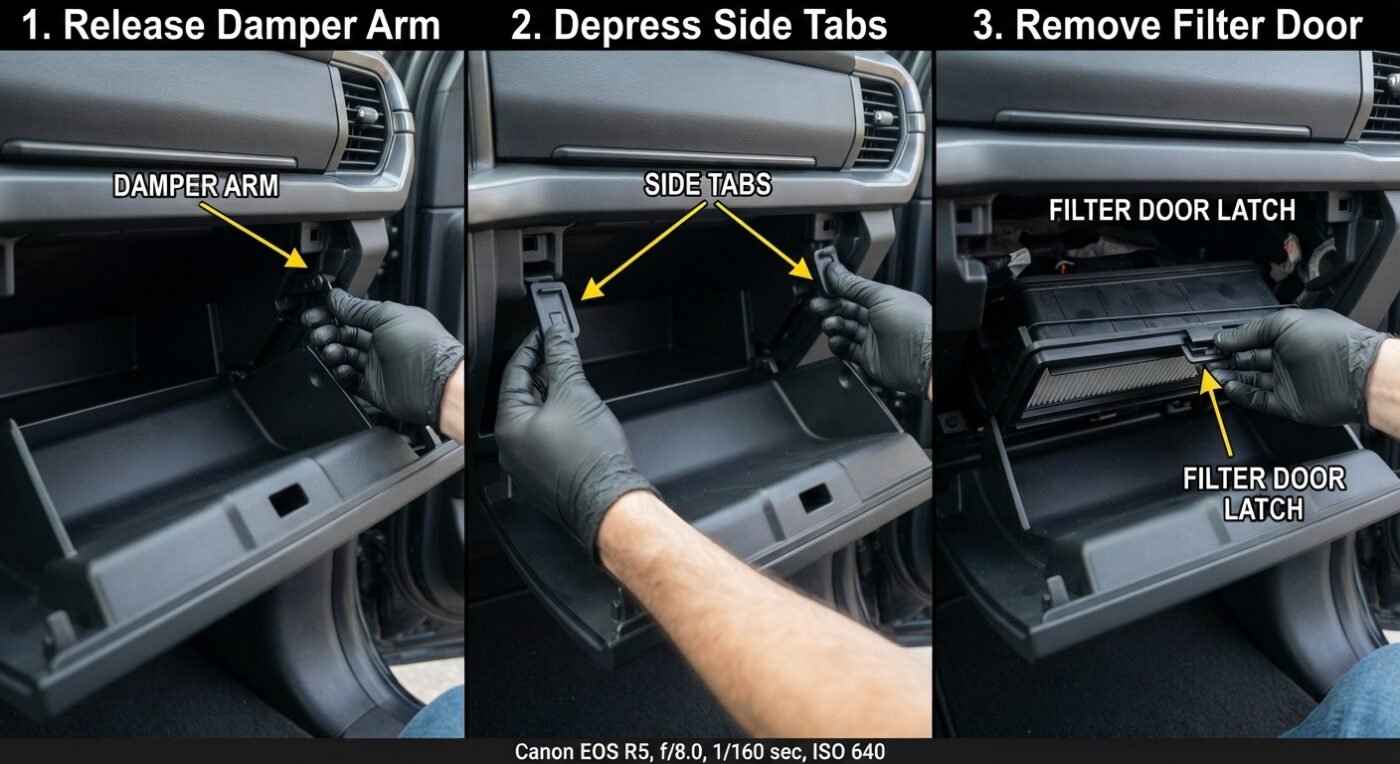
Drop the glovebox by releasing the soft-close damper arm and the side tabs. Unclip the plastic filter door and slide the old filter out horizontally. Seat the new pleats flat so the door latches without crushing the filter edge.
Ford Mustang (2015–2023)
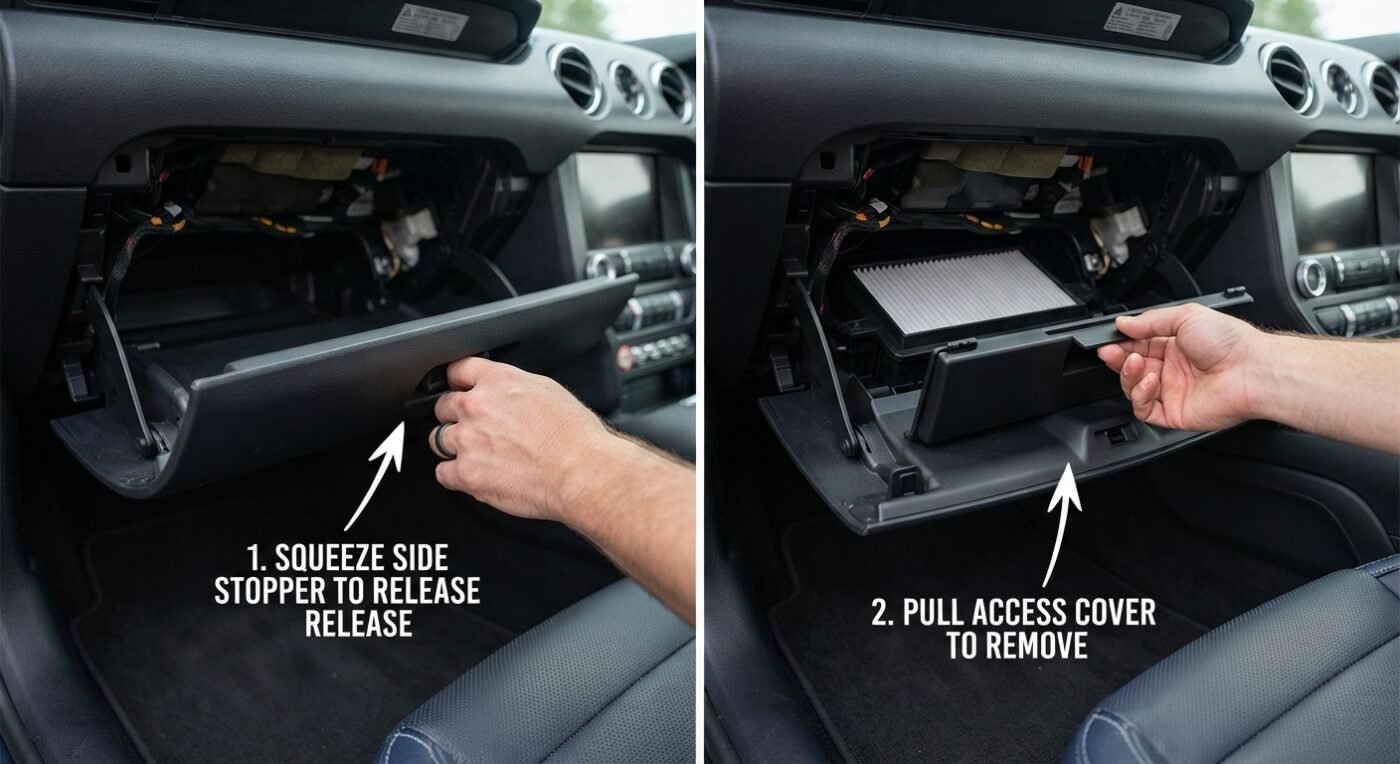
Squeeze the glovebox side stoppers and lower it. Undo the two T20 Torx screws or plastic clips on the access cover, then slide the filter out.
Ford Ranger (2019–2023)
Release the damping arm on the right side of the glovebox, press the side release tabs, and unclip the filter housing cover. Slide the old filter out.
Not sure which filter you need? Our best cabin air filters for the F-150, Mustang and Ranger guide covers all six we stock.
How Often to Change Cabin Air Filter
