
Air Filters, Cabin Air Filter
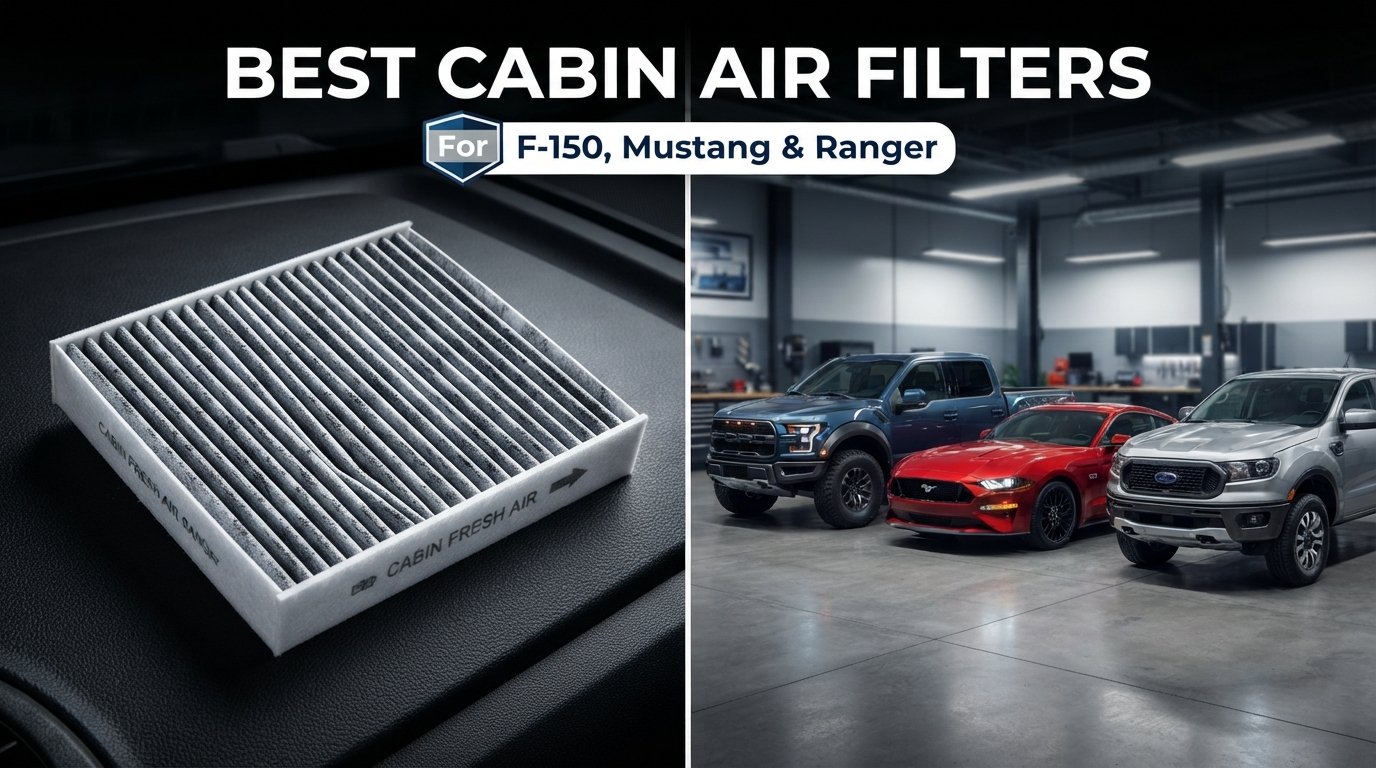
Best Cabin Air Filters for the Ford F-150, Mustang and Ranger
Oct
The best cabin air filter for most F-150, Mustang and Ranger owners is a plain STP particulate filter at $23 to $25. It fits, it’s cheap, and it does the basic job. Pay up for the STP Max ($31, F-150 only) if odors are the problem, because it’s the only carbon filter of the six we stock. Choose a washable K&N ($43 for the F-150, $45 for the Mustang) if you’d rather clean than replace. None of the six claims HEPA, and cabin filters aren’t MERV-rated, as explained below.
Table of Contents
Quick picks by model
| Model | Pick | Price | Why |
|---|---|---|---|
| F-150 (2015–2023) | STP CAF1953P | $25 | Disposable particulate, lowest price |
| F-150 (2015–2023) | STP Max CAF1953M | $31 | Carbon-infused, for odors |
| F-150 (2015–2023) | K&N VF2049 | $43 | Washable and reusable |
| Mustang (2015–2023) | STP CAF1925P | $24 | Disposable particulate |
| Mustang (2015–2023) | K&N VF2053 | $45 | Washable and reusable |
| Ranger (2019–2023, 2.3L EcoBoost) | STP CAF15030P | $23 | The only Ranger option we stock |
We have lab-tested all of these. The picks come from what each filter is, according to its manufacturer spec sheet, and its price.
If you drive a Ranger or Mustang and want carbon, we don’t stock one for those two yet. The STP Max is F-150 only.
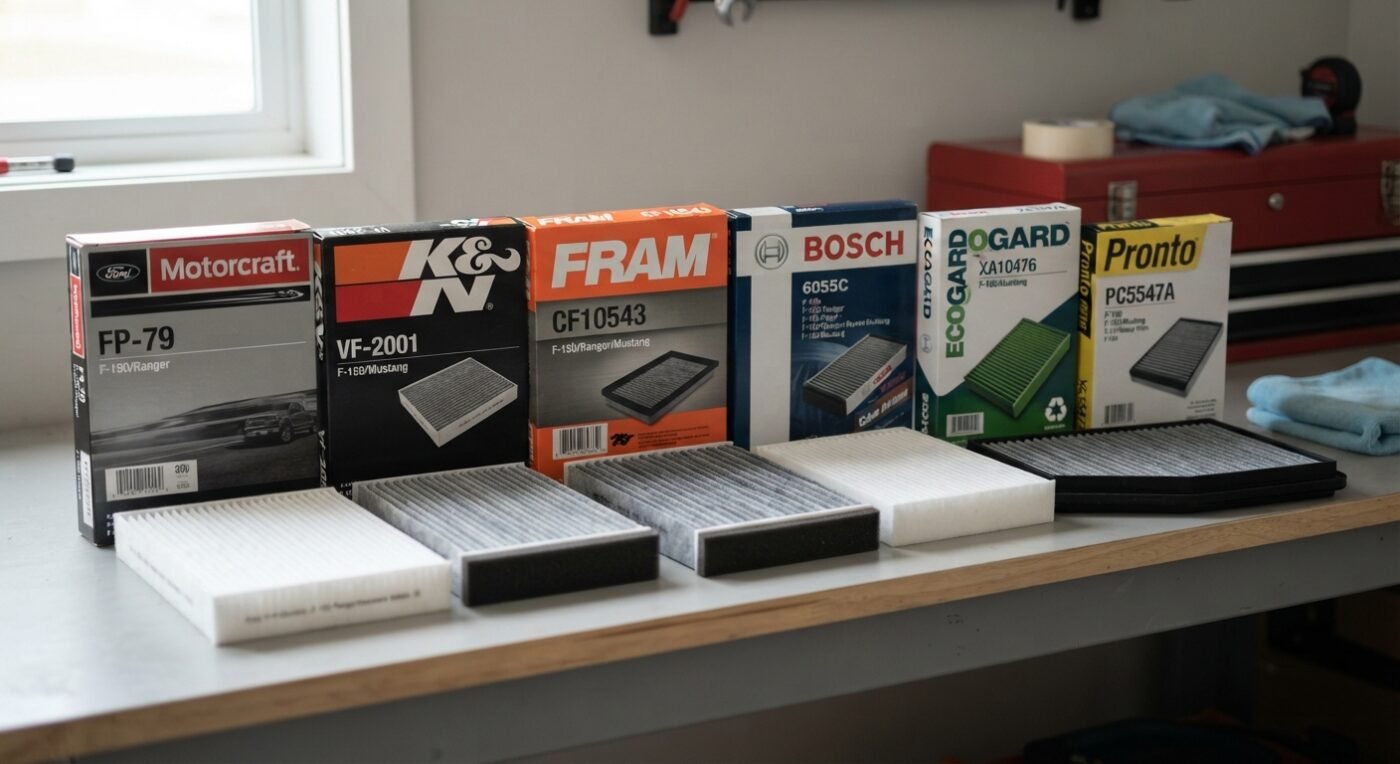
All six filters side by side
| Filter | Price | Media | Carbon | Washable | Fits | Warranty |
|---|---|---|---|---|---|---|
| STP CAF1953P | $25 | Synthetic particulate | No | No | 2015–2023 F-150, all engines | 12 mo / 12,000 mi |
| STP Max CAF1953M | $31 | Carbon-infused microfiber | Yes | No | 2015–2023 F-150, all trims | 12 mo / 12,000 mi |
| K&N VF2049 | $43 | Premium synthetic | No | Yes | 2015–2023 F-150 | 10 yr / 100,000 mi |
| STP CAF1925P | $24 | Synthetic particulate | No | No | 2015–2023 Mustang (S550) | 12 mo / 12,000 mi |
| K&N VF2053 | $45 | Premium synthetic | No | Yes | 2015–2023 Mustang | 10 yr / 100,000 mi |
| STP CAF15030P | $23 | Synthetic particulate | No | No | 2019–2023 Ranger (2.3L EcoBoost) | 12 mo / 12,000 mi |
The spec sheets list a “standard particulate” rating for the STP filters, antimicrobial protection (Microban) on the STP Max, and electrostatically charged high-airflow media on the K&N filters. Those are manufacturer claims, and none of the six lists a HEPA or N95 claim.
Particulate or activated carbon: which do you need?
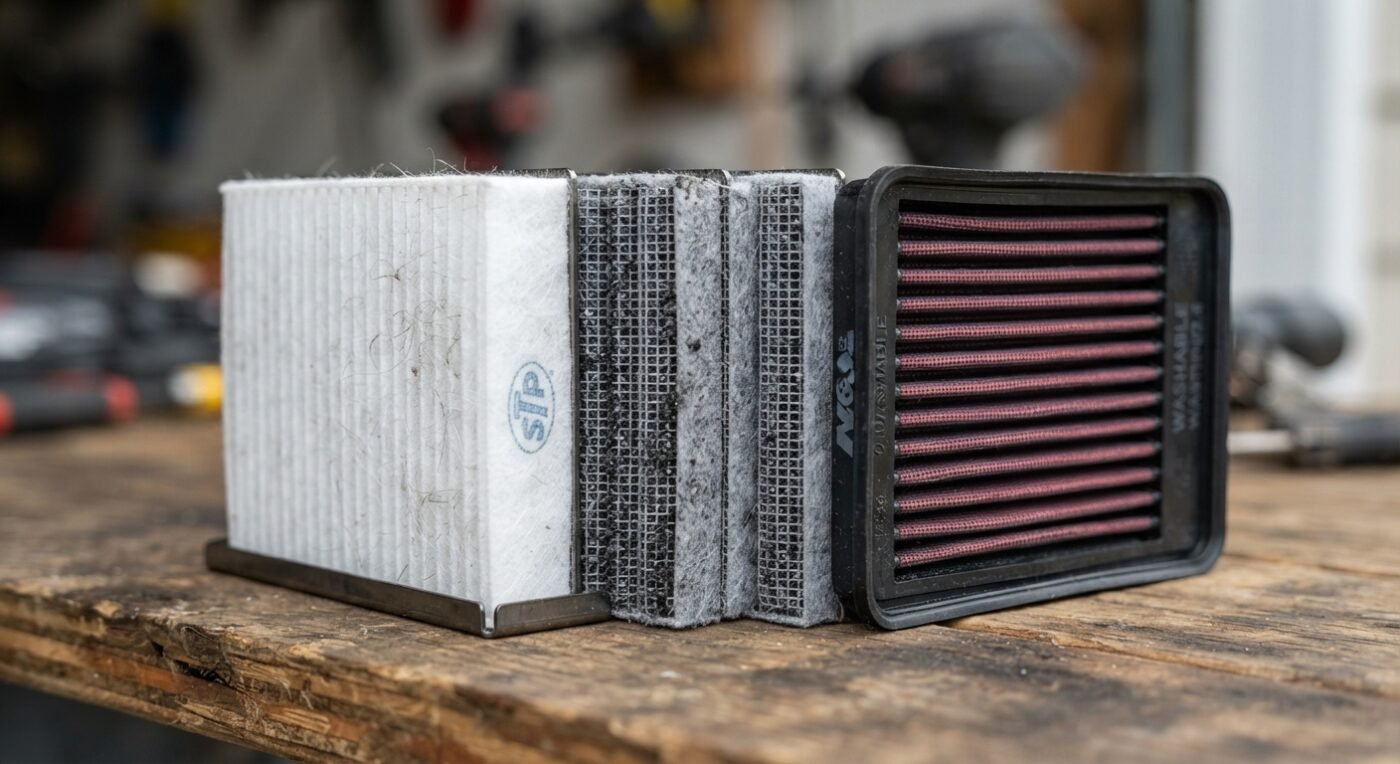
A particulate filter catches solid stuff: pollen, road dust, brake and tire wear, soot. A carbon filter does that too, and the carbon layer also binds gases and odors, such as ozone and nitrogen dioxide, according to filter maker MEYLE. Particle efficiency doesn’t tell you anything about gas removal, and carbon doesn’t guarantee HEPA-level particle capture. They’re different jobs.
- Choose the STP particulate ($23–$25) if you mostly want dust and pollen out and care about price.
- Choose the STP Max ($31, F-150) if odors bother you: exhaust, smoke, construction dust smell.
- Skip carbon if you’re on a Mustang or Ranger, since we don’t stock one for those.
One honest limit: no cabin filter is carbon monoxide protection. If you smell exhaust inside the truck, fix the source, not the filter.
Washable K&N or disposable: does the extra cost pay off?
The K&N costs more up front, needs cleaning, and has no carbon. It’s washable, and it carries a 10-year, 100,000-mile limited warranty.
Here’s the arithmetic on list prices. Say you replace the disposable F-150 filter every 20,000 miles (Ford’s interval, covered below). Over 100,000 miles that’s five STP CAF1953P filters at $25, or $125. The K&N VF2049 is $43, plus a cleaning kit at $15. If you clean it four times and each kit is good for one cleaning, that’s $43 plus $60, or $103. If one kit covers all four cleanings, it’s $58.
That’s simple arithmetic, not a guarantee. It also ignores your time: washing and drying takes effort, and the refresher step comes after. K&N’s cleaning steps, in short:
- Spray the K&N cleaner on both sides.
- Rinse with low-pressure tap water.
- Let it air dry. No compressed air or heat.
- Lightly spray on the K&N refresher before reinstalling.
HEPA and MERV on the box: what they mean
Cabin filter HEPA
HEPA is a defined standard: 99.97% of particles at 0.3 microns, according to filter makers such as Bosch. It isn’t a generic word for “better.” The trade-offs are real. A tighter filter can strain the climate control and cut airflow, and HEPA handles particles only, not odors or gases. None of the six filters here claims HEPA. If you need HEPA, we don’t have one for these trucks.
MERV rating for cabin air filters, explained
MERV is a rating system for home and building HVAC filters. According to a US cabin filter maker, cabin filters aren’t tested to it, and a “MERV 13 equivalent” on a cabin filter box is an estimate, not a test result. Cabin filters have their own test standards: ISO/TS 11155-1 for particles and ISO 11155-2 for gases. None of our spec sheets lists a MERV rating, so don’t pay extra for one.
Cabin air filter vs engine air filter: the difference
They’re different parts for different jobs. The engine air filter cleans the air going into the engine before combustion. The cabin air filter cleans the air coming in through the heating and A/C vents for you and your passengers. The engine filter protects the engine, and the cabin filter protects the people. This guide covers cabin filters only.
How to swap it, and when
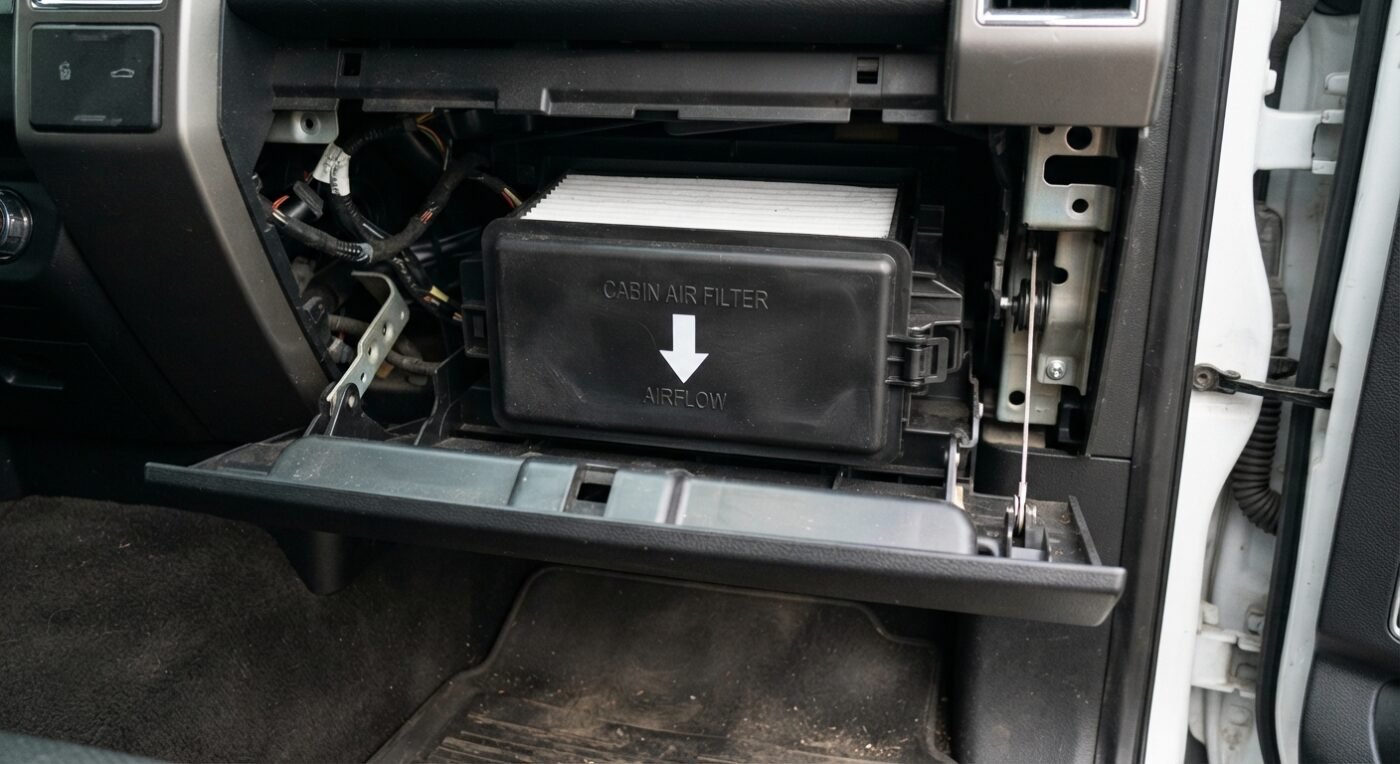
- F-150 (2015–2023): behind the glove box. Lower the damper arm, pinch the side tabs, and drop the access door. Slide the old filter out. The arrow points down. Seat the pleats flat so the door latches without crushing the filter edge.
- Mustang (2015–2023): in the passenger footwell under the dash. Remove the trim clips, unlatch the access door, and pull the filter out. Arrow points down.
- Ranger (2019–2023): behind the glove box. Release the damping cable, squeeze the tabs, lower the glove box, and remove the access cover. Arrow points down.
When to replace: Ford’s owner’s manual standard is every 20,000 miles or one year, sooner (about 10,000–12,000 miles) in severe dust, construction zones or heavy smog. Other sites quote different intervals, so go with the manual.
Fleet managers
Cabin filters are cheap, but across a fleet the numbers add up. Pick one filter per model, set the interval in your maintenance schedule, and shorten it for trucks working in dust. Washable K&N filters cut how many filters you buy, but only if someone actually cleans them on time. Use the arithmetic above with your own interval and labor cost.

Pingback: How Often to Change Cabin Air Filter: Ford F-150, Mustang and Ranger - Best Spare Part Plug